
Tags
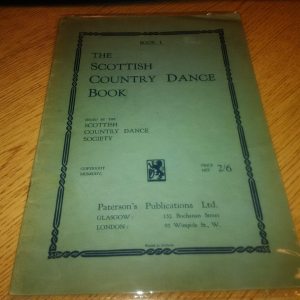
I recently acquired a first edition printing of the first book ever produced by the Royal Scottish Country Dance Society, and it makes for fascinating reading.
This was published before the RSCDS (called the SCDS in those days, as the Society did not achieve royal patronage until 1947) had standardized its terminology, figures, and number of couples in a set.
As a result, some interesting and intriguing differences exist in this format, which have disappeared from other editions.
The PDF* of this document can be found here:
Below are my notes on the things I saw that were markedly different from dancing today.
“Foreword”
- In the very first figure, five couples are indicated as the set length, and “five or six” couples are considered to be “a good number” for the amount in a set
- Dancers are expected to curtsey/bow to their partners and their “vis-a-vis” (neighbors)
- Musical timing is given in the format of “horse trotting” (strathspey) and “horse cantering” (reel)
- Balance in line is specified with “holding their hands high”, which could mean anything from shoulder-height to far above their heads
- Women are instructed to “hold their gown lightly between the forefinger and thumb” while dancing
- Pousette looks very odd in this edition, with the couples not moving as a unit, but rather one person in the pair always acting as the post
- Allemande is considered to be a form of pousette in this edition, and it is done in a backwards promenade hold (all hands behind the back, right hands at woman’s right waist, left hands at man’s left waist), and is danced with pas de basque
- Reels of three always take 6 bars and are always started giving right shoulders, according to this edition, versus reels of four, which take 8 bars, and one passes one’s own gender on the left and opposite gender on the right
- There are no notations with regards to time signatures (jig, strathspey, reel, hornpipe) that appear in later editions
- There is no distinction between “leading” and “dancing” down the middle and up; “leading” is sometimes used for inner hands joined, “dancing” is often used for right hand in right, and neither term appears on occasion, just the words “down the middle and up”
“Petronella”
- (No noticeable differences)
“The Triumph”
- The directions include an alternate ending in which the first and second couples pousette with each other to change places, instead of the first couple dancing a solo pousette to the bottom of a four-couple set
“Circassian Circle”
- The directions in which rights and lefts is referred to as “right and left”, and it is broken into two separate 4-bar figures instead of being presented as an 8-bar figure
- The same can be said for ladies chain, which is presented in two 4-bar pieces instead of one 8-bar figure
- Lastly, the dance is meant to go on until everyone meets up with their original couple they faced at the beginning
“The Nut”
- This dance requires that balance in line be danced with hands held high, which makes me think that they were raised above the heads of the dancers instead of at shoulder height
“Meg Merrilees”
- (No noticeable differences)
“Flowers of Edinburgh”
- (No noticeable differences)
“Strip the Willow” or “Drops of Brandy”
- (No noticeable differences)
“Clean Pease Strae” or “Broun’s Reel” (a.k.a. “Duke of Perth”)
- The names are specified as “Clean Pease Strae” (instead of the more simple “Pease Strae”) and “Broun’s Reel”, while the title “Duke of Perth” appears only on the page with the music
- The first turn by the right lasts for 4 bars (bars 1-4), and the turn by the left to complete the phrase is only 2 bars (bars 7-8); modern versions of this dance have this backwards, with the first couple turning by the right for 2 bars, casting to second place, and turning by the left for 4 bars
- Instead of “second couple step up” on bars 5-6, the couple are instructed to “take a slip step towards the top of the room”
- Turn Corners and Partner appears to become a modified chain, with the first couple turning halfway by the left instead of dancing a full turn and then proceeding to the next corner (this feels a bit more comfortable)
- The reel of three at the end specifies first woman dancing with the “third and second men”, and first man dancing with the “second and third women”, indicating to me that it is a right-shoulder reel of three with the lady dancing down and the man up, instead of a left-shoulder reel of three.
- The last two bars (31-32) specifies that the first couple “trip over to own side” instead of the first couple crossing while giving right hands
“Rory O’More”
- The first and second couples are instructed to “take nearest hand, holding them high”, which could mean anything from shoulder-height to above their heads
- First couple are instructed to go down the middle, “and, up again backwards”; which could mean they are traveling back up with their backs to the music
“Fight About the Fireside”
- There is no indication that the second couple steps up to first place during the dance, which means that there is less distance for the first woman to cover from the down the middle and up (first phrase) into the reel of three (second phrase), and even set to and turn corners seems to occur in this much smaller space
“Cumberland Reel”
- A notation at the bottom of the instructions indicates that “the first couple remain at the bottom of the dance, and the Second couple now take their place at the top, and repeat the figure”. The word “figure” leads me to believe that the the second couple is repeating the last 4 bars of the dance, not beginning the dance as the new first couple.
“Merry Lads of Ayr”
- This dance also does not indicate where the second couple steps up, and, as a result, the figures set to and turn corners could be interpreted to occur in a very small space
- The notation for the participants for the reel of three is the same as in “Duke of Perth”, and it makes it look like the reel is a right-shoulder reel of three with lady down, man up, instead of a left-shoulder reel of three with lady up, man down – the explanatory figure even specifies it!
- The “trip over to own side” notation is also specified in this dance for the last 2 bars, instead of first couple crossing while giving right hands
* As the first edition of RSCDS Book I is out of print, I have chosen to preserve this document in the PDF format, and to present it on this website for the use of other dancers and instructors who share my passion for Scottish Country Dancing. Enjoy!
 elizabethhumphriesdotnet