• About

elizabethhumphriesdotnet

elizabethhumphriesdotnet

Author Archives: Mrs. Montrose

Final Reels

31 Monday Jul 2017

Posted by Mrs. Montrose in RSCDS, scottish country dancing

≈ Leave a comment

Below is an alphabetical list of high-energy reels which are most often used as the final dance on a program.

  • “Australian Ladies”
  • “Da Rain Dancin'”
  • “The De’il Amang the Tailors”
  • “General Stuart’s Reel”
  • “The Highlandman Kissed His Mother”
  • “The Left-Handed Fiddler”
  • “Mairi’s Wedding”
  • “Mrs. MacPherson of Inveran”
  • “Mrs. Macleod”
  • “The Montgomeries Rant”
  • “The Reel of the 51st Division”
  • “The Reel of the Royal Scots”
  • “Sleepy Maggie”
  • “The Wind That Shakes the Barley”

I’ve listed them in my order of preference below

  1. “Mrs. MacPherson of Inveran” – perfect final dance in my opinion; no setting, energy builds steadily throughout, great kilt-flip moment at the end of the third phrase going into the fourth
  2. “The Australian Ladies” – minimal setting, lots of room for twiddling
  3. “Da Rain Dancin'” – love the title tune, very high energy
  4. “The De’il Amang the Tailors” – another great title tune, but a bit rougher on the body due to the first phrase; difficult to maintain the energy
  5. “General Stuart’s Reel” – I find the music is often played too slow to warrant its place at the end of a program, but when it’s played to speed, it’s magic
  6. “The Highlandman Kissed His Mother” – has set-to-and-turn-corners;
  7. “Mrs. Macleod” – has set-to-and-turn-corners;
  8. “Sleepy Maggie” – has set-to-and-turn-corners; the transition from the end of the first time through the dance to the second can be magical, but all-too-often the new 2nd Couple is not ready to launch into the circle once round to the left
  9. “The Montgomeries Rant” – lively music; requires a great partner to be successful
  10. “The Reel of the Royal Scots” – the transition from the third phrase into the circle is fantastic so long as it’s phrased properly; the music is enhanced by the use of pipes; I placed it lower in my list due to its ubiquity
  11. “The Reel of the 51st Division” – most often used due to its music and story; I’ve danced it
  12. “Mairi’s Wedding” – I don’t appreciate the music as much as I would like to, and the reel across the dance during the 4th phrase is jarring and ruins the flow
  13. “The Left-Handed Fiddler” – with the right music, this dance is amazing; seasoned dancers will find themselves fighting the urge to use their right hand when the left hand is required, which breaks the spell of the dance
  14. “The Wind That Shakes the Barley” – I’m not a huge fan of corner-partner-corner-partner in quicktime as most dancers have difficulty with this figure
 

“Circassian Circle” (I.3)

25 Tuesday Jul 2017

Posted by Mrs. Montrose in Book I, RSCDS, scottish country dancing

≈ Leave a comment

32-bar Reel for 2 Couples Round the Room, RSCDS I

I have never danced this dance. The areas in which I dance do not do many “round the room” dances, so I have no personal experience with it.

Here are some notes for you from The Scottish Dance Dictionary.

My observations below are based on my reading of the dance.

  1. It feels like an English dance, especially with regards to the pousette progression
  2. The double setting and turning could be very taxing, though figures are simple altogether
  3. The pousette can be difficult if the dancers do not remember which direction they are facing coming out of the figure
  4. It seems a solid choice for teaching orientation
  5. Perhaps a good option for the “novelty” part of a dance program


“Triumph” (I.2)

18 Tuesday Jul 2017

Posted by Mrs. Montrose in Book I, RSCDS, scottish country dancing

≈ Leave a comment

24-bar Reel for a 4-Couple Set, RSCDS I

This is a fun little dance. I say “fun” because the triumph hold and the traveling pousette are very rare in the canon, and both offer challenges and opportunities for practicing precision. It’s often found in the beginning or near the end of programs because the dance is not physically demanding. It is “little” because it is 24 bars in length, while the standard length of the average dance is 32 bars.

I like “Triumph” and will often choose to dance it with a newer dancer so they can learn the traveling pousette.

Characteristics

  • Set Management: it’s a one-person dance, which means that if only one person in the set knows how it goes, they can get the other seven through it
  • Technical Requirements: moderate (pas de basque, skip change, one-couple traveling pousette)

Teaching Points

  • Figure – the traveling pousette benefits from being taught/learned in the classroom setting, but it is not strictly necessary as it can be picked up on the dance floor
  • Footwork – must have a three-beat pas de basque with a proper jeté to be able to progress through the traveling pousette
  • Foot change(s) – M1 switches from left to left on bar 16, then from right to right on bar 24
  • Handing – getting into and out of the Triumph hold should be natural and unobtrusive
  • Deportment – especially crucial when dancing up “in triumph” and dancing the traveling pousette
  • Phrasing – the phrasing of the traveling pousette requires attention

Social Program

“Triumph” can appear anywhere in the program except the end, but it’s a good idea to place it in the midst of more physically-demanding dances as it offers a respite from a lot of activity.

  • 6 – would not recommend
  • 12 – 3rd or 9th dance
  • 15 – 6th or 12th dance
  • 18 – 6th, 12th, or 15th dance

Physical Experience

  • Minimal impact on the body, so a good choice for all sorts of dancers

Regional Variation

  • (None known to the author)

“Petronella” (I.1)

17 Monday Jul 2017

Posted by Mrs. Montrose in Book I, RSCDS, scottish country dancing

≈ Leave a comment

I struggled with how to begin this series of analyses, given that much of it will be based on my personal experience as opposed to an academic exploration of a dance within the context of the Scottish country dance repertoire or an innocuous fluff piece on its teaching points. The saying is “begin as you mean to continue”, so shall we start by speaking freely about the first dance in the first book published by the RSCDS?

32-bar Reel for Two Couples, RSCDS I

Please note that there is a distinction between the petronella movement (two bars) and the Petronella figure (16 bars).

“Petronella” is a great teaching dance and a solid option for a social dance program, but it’s very hard on the body. I usually opt to sit it out when I see it on a program unless one of my favorite pousette partners is available to dance with me, or a newer dancer requires an experienced partner to guide them through it.

It is often favored by younger dancers because they can dance it with vigor. People who are new to SCD may also enjoy it as the floor pattern is easy to navigate.

Characteristics

  • Set Management: it’s a one-person dance, which means that if only one person in the set knows how it goes, they can get the other seven through it
  • Technical Requirements: simple (pas de basque, skip change, petronella movement, pousette)

Teaching Points

  • Footwork – must have a three-beat pas de basque with a proper jeté to be able to progress through the Petronella figure and the pousette
  • Foot change(s) – M1 switches from left to left on bar 24, then from right to right on bar 32
  • Deportment – practice keeping upright while maintaining relaxed arms during the 16-bar Petronella figure
  • Covering – evident during the Petronella figure and the pousette
  • Phrasing – no tricky phrasing bits, but lead couple should be considerate of the 2nd Couple while leading down the middle and up as they need to be above them by bar 7 so they may step in for the pousette

Social Program

“Petronella” feels easiest to dance when preceded by a medium-energy jig and a strong strathspey to warm up my legs, and followed by a soft jig and a set dance strathspey to allow for cool-down. I like it best when it’s earlier in the dance program, as I tend to have more energy then.

  • 6 – 3rd dance
  • 12 – 6th dance
  • 15 – 6th dance
  • 18 – 6th dance

Physical Experience

  • Twenty-four bars of proper pas de basque is rough on anyone’s body, and 144 bars in total of it during less than four minutes is downright brutal, so a dancer should consider removing the jeté during the “set in place” part of the Petronella movement to ease the strain on the legs

Regional Variation

  • Often the 2nd Couple will step up on bars 1-2 and join the lead couple for the Petronella figure; W2 has a relatively short Petronella movement to her right on bars 15-16, but M2 must figure out a way to head home, either by means of skip change or a long petronella turn

Personal Analyses & Oral Traditions

28 Wednesday Dec 2016

Posted by Mrs. Montrose in scottish country dancing

≈ Leave a comment

The RSCDS, the Teacher’s Association of Canada, and many other groups and individuals have collected and published teaching points and notes on Scottish Country Dancing.

I will be publishing my own on this blog from the perspective of the dance’s features, and its use in a class, a social dance, a performance, and a ball.*

Some dances are excellent for teaching figures or footwork, while others shine in a social setting. Certain dances have interesting trivia associated with their names, figures, or date of publication. There are figures which have been interpreted differently than they were originally composed, have been incorrectly interpreted, or are just awkward on the most basic level and confusing as to why they even exist.

Each analysis will include my observations on what level of technique and experience a dancer, a couple, or a set requires, as well as my personal notes on the transitions, the overall “flow” of the figures, and the level of energy and stamina each requires.

The format will be as such:

  • Name | Book – identifying the source material
  • Time Signature | Bars | Couples | Set Formation – basic information about the composition
  • Dancer | Couple | Group – what level of technique is required to dance it well
  • Teaching | Social | Performance | Ball – the best way to experience the dance
  • Placement in Program – if suitable for a social event, where it should fall in the roster
  • Modifications – how to modify the dance if there are less or more couples than are required
  • My Personal Notes – my personal interpretation, local variations, and general appreciation of the dance.

I will also write up information on how to compose lesson plans, social dances, ball programs, and other items on subjects that are not usually published, but rather taught and learned mainly through conversation.

It is my hope that you, the reader, finds these notes of some use to you, whether you are a dancer, a teacher, or a student of the history of Scottish Country Dancing.

*  A special thanks to James Gaffney of the Delaware Valley Branch of the RSCDS for inspiring this series.

RSCDS Book I – First Edition (1924)

04 Friday Mar 2016

Posted by Mrs. Montrose in scottish country dancing

≈ Leave a comment

Tags

rscds book i

book i

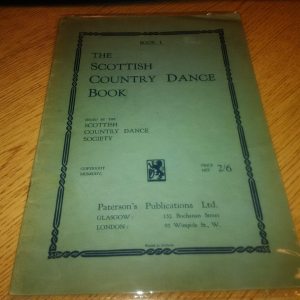
I recently acquired a first edition printing of the first book ever produced by the Royal Scottish Country Dance Society, and it makes for fascinating reading.

This was published before the RSCDS (called the SCDS in those days, as the Society did not achieve royal patronage until 1947) had standardized its terminology, figures, and number of couples in a set.

As a result, some interesting and intriguing differences exist in this format, which have disappeared from other editions.

The PDF* of this document can be found here:

Book I – First Edition (1924)

Below are my notes on the things I saw that were markedly different from dancing today.

“Foreword”

  • In the very first figure, five couples are indicated as the set length, and “five or six” couples are considered to be “a good number” for the amount in a set
  • Dancers are expected to curtsey/bow to their partners and their “vis-a-vis” (neighbors)
  • Musical timing is given in the format of “horse trotting” (strathspey) and “horse cantering” (reel)
  • Balance in line is specified with “holding their hands high”, which could mean anything from shoulder-height to far above their heads
  • Women are instructed to “hold their gown lightly between the forefinger and thumb” while dancing
  • Pousette looks very odd in this edition, with the couples not moving as a unit, but rather one person in the pair always acting as the post
  • Allemande is considered to be a form of pousette in this edition, and it is done in a backwards promenade hold (all hands behind the back, right hands at woman’s right waist, left hands at man’s left waist), and is danced with pas de basque
  • Reels of three always take 6 bars and are always started giving right shoulders, according to this edition, versus reels of four, which take 8 bars, and one passes one’s own gender on the left and opposite gender on the right
  • There are no notations with regards to time signatures (jig, strathspey, reel, hornpipe) that appear in later editions
  • There is no distinction between “leading” and “dancing” down the middle and up; “leading” is sometimes used for inner hands joined, “dancing” is often used for right hand in right, and neither term appears on occasion, just the words “down the middle and up”

“Petronella”

  • (No noticeable differences)

“The Triumph”

  • The directions include an alternate ending in which the first and second couples pousette with each other to change places, instead of the first couple dancing a solo pousette to the bottom of a four-couple set

“Circassian Circle”

  • The directions in which rights and lefts is referred to as “right and left”, and it is broken into two separate 4-bar figures instead of being presented as an 8-bar figure
  • The same can be said for ladies chain, which is presented in two 4-bar pieces instead of one 8-bar figure
  • Lastly, the dance is meant to go on until everyone meets up with their original couple they faced at the beginning

“The Nut”

  • This dance requires that balance in line be danced with hands held high, which makes me think that they were raised above the heads of the dancers instead of at shoulder height

“Meg Merrilees”

  • (No noticeable differences)

“Flowers of Edinburgh”

  • (No noticeable differences)

“Strip the Willow” or “Drops of Brandy”

  • (No noticeable differences)

“Clean Pease Strae” or “Broun’s Reel” (a.k.a. “Duke of Perth”)

  • The names are specified as “Clean Pease Strae” (instead of the more simple “Pease Strae”) and “Broun’s Reel”, while the title “Duke of Perth” appears only on the page with the music
  • The first turn by the right lasts for 4 bars (bars 1-4), and the turn by the left to complete the phrase is only 2 bars (bars 7-8); modern versions of this dance have this backwards, with the first couple turning by the right for 2 bars, casting to second place, and turning by the left for 4 bars
  • Instead of “second couple step up” on bars 5-6, the couple are instructed to “take a slip step towards the top of the room”
  • Turn Corners and Partner appears to become a modified chain, with the first couple turning halfway by the left instead of dancing a full turn and then proceeding to the next corner (this feels a bit more comfortable)
  • The reel of three at the end specifies first woman dancing with the “third and second men”, and first man dancing with the “second and third women”, indicating to me that it is a right-shoulder reel of three with the lady dancing down and the man up, instead of a left-shoulder reel of three.
  • The last two bars (31-32) specifies that the first couple “trip over to own side” instead of the first couple crossing while giving right hands

“Rory O’More”

  • The first and second couples are instructed to “take nearest hand, holding them high”, which could mean anything from shoulder-height to above their heads
  • First couple are instructed to go down the middle, “and, up again backwards”; which could mean they are traveling back up with their backs to the music

“Fight About the Fireside”

  • There is no indication that the second couple steps up to first place during the dance, which means that there is less distance for the first woman to cover from the down the middle and up (first phrase) into the reel of three (second phrase), and even set to and turn corners seems to occur in this much smaller space

“Cumberland Reel”

  • A notation at the bottom of the instructions indicates that “the first couple remain at the bottom of the dance, and the Second couple now take their place at the top, and repeat the figure”.  The word “figure” leads me to believe that the the second couple is repeating the last 4 bars of the dance, not beginning the dance as the new first couple.

“Merry Lads of Ayr”

  • This dance also does not indicate where the second couple steps up, and, as a result, the figures set to and turn corners could be interpreted to occur in a very small space
  • The notation for the participants for the reel of three is the same as in “Duke of Perth”, and it makes it look like the reel is a right-shoulder reel of three with lady down, man up, instead of a left-shoulder reel of three with lady up, man down – the explanatory figure even specifies it!
  • The “trip over to own side” notation is also specified in this dance for the last 2 bars, instead of first couple crossing while giving right hands

*   As the first edition of RSCDS Book I is out of print, I have chosen to preserve this document in the PDF format, and to present it on this website for the use of other dancers and instructors who share my passion for Scottish Country Dancing.  Enjoy!

In the year 1995…

29 Monday Feb 2016

Posted by Mrs. Montrose in scottish country dancing

≈ Leave a comment

I began my study of Scottish Country Dancing at Bryn Mawr College under the tutelage of Jane Kingsley, Carleta McCain, and Joanna Reiner.

I was eighteen years old, completely uncoordinated, and quite lost.

One would like to think that I have come a long way since then, but as an eternal student of this dance form, I know that I have much more to learn.

This blog will be devoted to a great many thing that interest me, and much of it will encompass my love of this activity, including all of the technical aspects, artistic choices, and social enjoyment that one can look forward to in the pursuit of Scottish Country Dancing.

Subscribe

  • Entries (RSS)
  • Comments (RSS)

Archives

  • July 2017
  • December 2016
  • March 2016
  • February 2016

Categories

  • Book I
  • RSCDS
  • scottish country dancing

Meta

  • Create account
  • Log in

Create a free website or blog at WordPress.com.

Privacy & Cookies: This site uses cookies. By continuing to use this website, you agree to their use.
To find out more, including how to control cookies, see here: Cookie Policy
  • Subscribe Subscribed
    • elizabethhumphriesdotnet
    • Already have a WordPress.com account? Log in now.
    • elizabethhumphriesdotnet
    • Subscribe Subscribed
    • Sign up
    • Log in
    • Report this content
    • View site in Reader
    • Manage subscriptions
    • Collapse this bar
 

Loading Comments...